-
 Emergency Call
(0274) 584 423
-
Phone
(0274) 544744 - 550380
- Indonesian
OFFICIAL WEBSITE
"Dr. YAP"
Eye Hospital
Featured Action / Phacoemulsification and IOL Premium
IOL Premium








Contact Us
Phone
(0274) 544744 - 550380
rsmata@yap.or.id
Location
Cik Di Tiro St. 5 Yogyakarta 55223
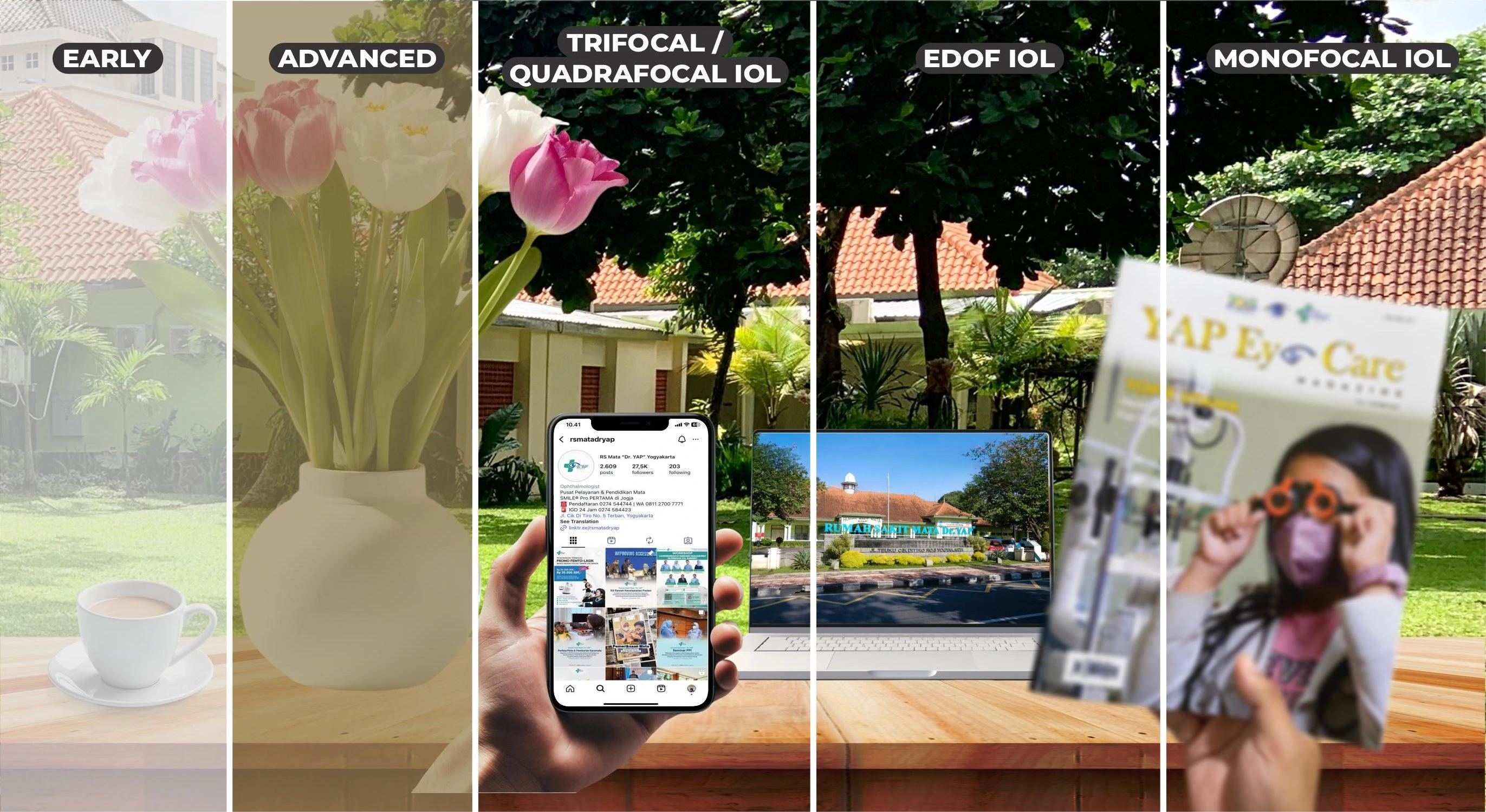
Cataract Surgery Using Premium Lenses
• About Cataract Surgery with Premium IOLs. Cataract surgery is one of the most commonly performed eye surgeries and has a very high success rate worldwide. This procedure involves removing the eye's natural lens, which has become cloudy, and replacing it with a clear artificial lens called an Intraocular Lens (IOL). The standard choice in cataract surgery is a Monofocal IOL, which is a lens that provides clear vision at a specific distance, generally for distance vision. Although effective and safe, most patients with monofocal IOLs still need glasses for near vision activities, such as reading, and intermediate distance activities, such as using a computer. For patients who want to reduce their dependence on glasses, Premium IOLs offer more advanced optical technology. These lenses are designed to provide better vision at multiple distances (near, intermediate, and far) and can be equipped with a toric component to correct cylinder or astigmatism.
• Why Choose Premium IOLs? Premium IOLs are intended for patients who want optimal vision quality and better visual comfort with minimal use of glasses. These lenses are ideal for individuals with active lifestyles, as they enable clear and comfortable vision for various daily activities such as driving, reading, and working with digital devices, without the need to frequently change glasses.
• Types of Premium Intraocular Lenses (IOLs). Premium IOLs are available in several designs, each with its own advantages in terms of range and quality of vision. An ophthalmologist will recommend the most suitable type of lens based on the results of a comprehensive eye examination and the patient's visual needs and priorities. The following are the types of Premium IOLs commonly used in cataract surgery:
1. Enhanced Monofocal (Monofocal-Plus) IOL
The Monofocal Plus lens is an advancement of the conventional monofocal design. This lens provides a slight extension of focus, making intermediate vision, such as when using a computer or looking at vehicle panels, more comfortable without compromising overall optical quality.
Advantages:
• Improved intermediate vision
• Relatively minimal risk of glare and halos
Limitations:
• Reading glasses are generally still needed for close-up activities
2. Multifocal IOL
Multifocal lenses work by dividing light into several focus zones for near, intermediate, and distance vision, similar to the principle of progressive glasses, but these lenses are permanently implanted in the eye. The brain will naturally select the sharpest image according to the viewing distance, and most patients can adapt well within a few weeks to a few months.
a. These lenses are ideal for patients who want to read books, use cell phones, or work on computers without relying on glasses. Trifocal lenses allow for smoother transitions between distances in various lighting conditions.
b. Approximately 15–20% of patients may experience visual effects such as halos or glare, especially at night. However, in most cases, these complaints are mild and will diminish as the patient adapts.
c. Multifocal lenses are suitable for patients who want clear vision at all distances and can tolerate mild visual effects at night. These lenses provide a high degree of independence from glasses, especially for near and intermediate activities.
d. The adaptation period generally lasts between 6 weeks and 3 months. Many patients report high long-term satisfaction with very few ongoing complaints. Various studies show stable and positive visual outcomes, with the majority of patients stating they would choose the same type of lens again.
Advantages:
• High level of independence from glasses for most activities
Limitations:
• Some patients may experience halos or glare around light sources, especially at night. However, some types of Modern Multifocal lenses are claimed to no longer cause halo or glare effects
• Mild contrast reduction may occur.
3. EDOF (Extended Depth of Focus) IOL
EDOF lenses extend the range of vision from distance to intermediate distances, as well as providing partial near vision. The optical principle is similar to a camera system with a wider depth of focus, resulting in more natural and continuous vision. This lens is excellent for sharp distance and intermediate vision, with minimal light reflection at night compared to conventional multifocal lenses.
a. Highly supports daily activities such as working with computers and using digital screens.
b. The risk of glare or halos is relatively lower, making it more comfortable for nighttime activities or driving. Many users experience a smooth transition in vision without sharp changes in focus, making it feel more natural.
c. Near vision is generally quite good, but reading glasses may still be needed for reading small print, especially in low light conditions. This is a compromise for better contrast quality and visual comfort.
d. Complaints about night vision are reported to be fewer compared to multifocal lenses. The adaptation process is also relatively quick, typically taking only a few days to a few weeks.
e. EDOF lenses are highly suitable for patients with an active lifestyle, who frequently drive at night, or who desire optimal visual quality with minimal visual side effects.
Advantages:
• Excellent distance and intermediate vision
• Lower risk of halos and glare compared to multifocal lenses
Limitations:
• For highly detailed close-up activities (such as reading small print), reading glasses may still be required or combined with mild monovision techniques.
4. Toric IOL
In patients with astigmatism due to irregular corneal shape, Premium IOL technology can be combined with toric features to correct cylinder while meeting the needs of distance and other vision. These lenses have different optical powers on specific axes, so that light focus becomes more even and sharp.
With this approach, patients can reap the visual benefits of Premium IOLs while correcting astigmatism in a single surgical procedure. The success of toric lenses is highly dependent on the accuracy of lens positioning and rotation during implantation. Precise placement ensures that the lens remains aligned on the correct axis so that visual acuity can be maintained over the long term.
To achieve optimal results, advanced surgical equipment and technology are used to help ensure accurate lens alignment and predictable outcomes.
Toric IOLs are available in various designs, including multifocal and EDOF, allowing patients to obtain a combination of astigmatism correction and a wider range of vision according to their needs.
Advantages:
• Provides sharp distance vision while correcting astigmatism, often without the need for glasses
• Corrects cylinder and age-related focusing issues (presbyopia) in a single surgical procedure
• Significantly reduces, and may even eliminate, the need for glasses after surgery
Limitations:
• In some patients, glasses may still be needed for close-up vision or fine details, depending on the type of lens used
• Choosing the Right IOL for You
Each type of Premium IOL has its own advantages and considerations. The selection of the most suitable lens depends on various factors, such as the patient's lifestyle, vision needs and preferences, and the recommendations of the ophthalmologist.
During the preoperative examination, the doctor will explain the various Premium IOL options available, including their benefits and limitations. Through this discussion, the doctor and patient will work together to determine the type of Premium IOL that best suits the individual's eye condition and visual needs, in order to achieve optimal and safe vision results.
• Stages and Important Considerations
Cataract surgery using a Premium Intraocular Lens (IOL) involves several important stages and is accompanied by various preventive measures before, during, and after the procedure to ensure optimal and safe visual outcomes. Here is a general overview:
❖ Pre-Operative Stages
1. Pre-operative Evaluation:
Before undergoing cataract surgery with a Premium IOL, patients will undergo a series of pre-operative examinations to assess their suitability for premium lenses and determine the type of IOL that best suits their eye condition and visual needs. These examinations include:
• Comprehensive Eye Examination: To assess the overall health of the eyes.
• Visual Acuity Examination: To determine the level of vision before surgery.
• Refraction Examination: To determine refractive errors such as nearsightedness, farsightedness, or astigmatism.
• Eye Biometry: A very important examination to calculate the strength of the IOL needed for optimal post-operative vision.
• Corneal Topography: This examination maps the curvature of the corneal surface and helps detect abnormalities such as astigmatism. This data is very useful in selecting the right type of IOL and in estimating the risk of refractive errors after surgery.
• Intraocular Pressure Measurement: Performed to detect the possibility of glaucoma, which may require special treatment or affect the surgical technique chosen.
• Dilated Fundus Examination: To evaluate the condition of the retina and optic nerve.
• Retinal Imaging Examination: In certain conditions, examinations such as Optical Coherence Tomography (OCT) are performed to detect pre-existing retinal abnormalities that may need to be treated before surgery.
• Corneal Endothelial Cell Count: In patients with certain conditions, such as Fuchs endothelial dystrophy, this examination is important to assess corneal endothelial health and estimate the risk of corneal complications after surgery.
2. Discussion of IOL Options
Patients will discuss various premium IOL options with their ophthalmologist, such as multifocal, toric, or other lens designs. The doctor will help determine the best choice based on the patient's lifestyle, daily activities, and vision needs.
3. Preoperative Medication Administration
Patients will receive explanations and instructions regarding the use of medications before surgery, such as eye drops, which are intended to prepare the eyes and reduce the risk of infection or inflammation.
4. Assessment of General Health Condition
The doctor will review the patient's medical history thoroughly to ensure that the patient is safe to undergo surgery and to identify possible risks or complications.
5. Review of Medications Currently Being Taken
The doctor will review the medications the patient is currently taking. Some medications may need to be adjusted or temporarily discontinued before surgery to reduce the risk of bleeding or other complications.
6. Post-Surgery Transportation Arrangements
Because the pupils are usually still dilated and vision may be blurred immediately after surgery, patients are advised to arrange transportation home and not to drive themselves after the procedure.
❖ Postoperative Care and Recovery
1. Recovery Room.
After the surgery is complete, patients will undergo a brief observation period in the recovery room. During this period, the patient's condition will be monitored and any initial post-operative complaints, such as mild discomfort, will be addressed before the patient is allowed to go home.
2. Eye Shield.
Patients will usually be given an eye shield to wear temporarily. This device protects the newly operated eye and prevents the patient from rubbing their eyes during the healing process.
3. Eye Drops and Medications.
The doctor will prescribe eye drops and/or other medications to prevent infection, reduce inflammation, and aid the healing process. It is very important for patients to use the medication according to the schedule and instructions given by the doctor.
4. Follow-up visits.
Patients will be scheduled for post-operative follow-up visits to monitor the healing process and evaluate vision results. During these visits, the doctor will also address any complaints or complications.
5. Activity Restrictions
During the initial recovery period, patients are advised to avoid strenuous activities, swimming, and rubbing their eyes to reduce the risk of infection or other complications.
6. Vision Rehabilitation
Vision takes time to stabilize completely, and the brain also needs time to adapt to the new lens. This process can take place gradually depending on the type of IOL used.
7. Routine Eye Care
After the recovery period is complete, patients are advised to continue undergoing routine eye examinations. This is important to monitor overall eye health and ensure that the Premium IOL continues to perform optimally in the long term.
❖ Things to Note (Post-Operative Prevention)
1. Avoid Rubbing Your Eyes
Rubbing your eyes can increase the risk of infection and potentially shift the position of the implanted lens.
2. Protect Your Eyes
Wear sunglasses with UV protection to shield your eyes from direct sunlight, dust, and foreign particles during the healing period.
3. Follow the Checkup Schedule
Regular checkups are very important to monitor the healing process of the eyes and detect possible complications early on.
4. Report Complaints Immediately
If you experience sudden changes in vision, severe pain, redness, or discharge from the eyes, contact your doctor or healthcare facility immediately.
5. Use Medication as Directed
Follow your doctor's instructions for using eye drops and prescribed medications to prevent infection and support optimal healing.
6. Activities to Postpone After Surgery
It takes several weeks before patients are allowed to use cosmetics around the eye area again. In addition, strenuous physical activities such as contact sports, swimming, or soaking in hot tubs should also be postponed for several weeks after surgery.
The safe time to resume daily activities may vary from patient to patient. Therefore, it is very important to follow the ophthalmologist's advice and recommendations regarding when patients can safely resume normal activities to ensure optimal healing and prevent complications.